Model Structure and the Use of Views
A Model is an abstraction composed by extracting and distilling the facts, concepts, rules, and behavior required by a Bounded Context into a coherent semantic boundary.
Part 4 explains the structure of a Model and the Views used to work with it. The Object Model is used as the main explanatory subject to make formal structure concrete and to clarify continuity with UP (Unified Process).
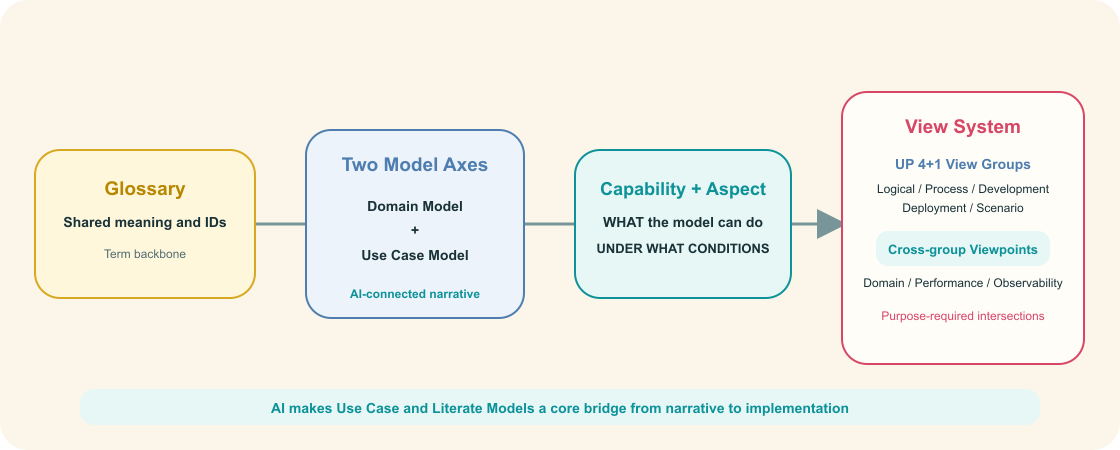
The Domain Model supplies an axis of meaning through concepts, relationships, rules, and decisions, while the Use Case Model supplies an axis of intent through Actors, Goals, Scenarios, and Outcomes. The two Model axes compose and examine Capabilities and Aspects as Model elements, and purpose-selected Domain, Use Case, and quality-attribute Views are used to work with the complex Model. The Object Model is the explanatory center for formal structure, not a supertype of the Model as a whole.
Position in the Series
Part 3 organized the relationship of the Object, Knowledge, and Literate Models to the Domain Model. Part 4 takes Model structure as its subject, reads Domain Model and Use Case Model as two axes, and explains how purpose-specific Views are used to work with that complex structure. The Object Model is central to the explanation of formal structure, while the relationship to the three Models is connected after the two axes and View System have been established.
Part 4 centers Model structure and the use of Views. It uses the Object Model to explain formal structure, organizes Domain Model and Use Case Model as two axes, and later relates them to the Object, Knowledge, and Literate Models. It distinguishes Application Modeling, which organizes Use Case realization as dynamic structure, from Model Realization, which connects approved Models to implementation and execution.
Previous article: 📄 Modeling Technology System
Model as a Bounded-Context Abstraction
Reality includes the current state, historical development, future possibilities, tacit rules, exceptions, multiple interpretations, and unobserved facts. A Model represents the subset required by the Purpose and Concerns of its Bounded Context.
Bounded Context Distills Reality into a Model
A Bounded Context is the domain-side semantic boundary within which language, meaning, rules, and responsibilities remain coherent. It selects the required scope from Reality, normalizes language, organizes concepts and rules, and distills them into a Model that can connect to execution.
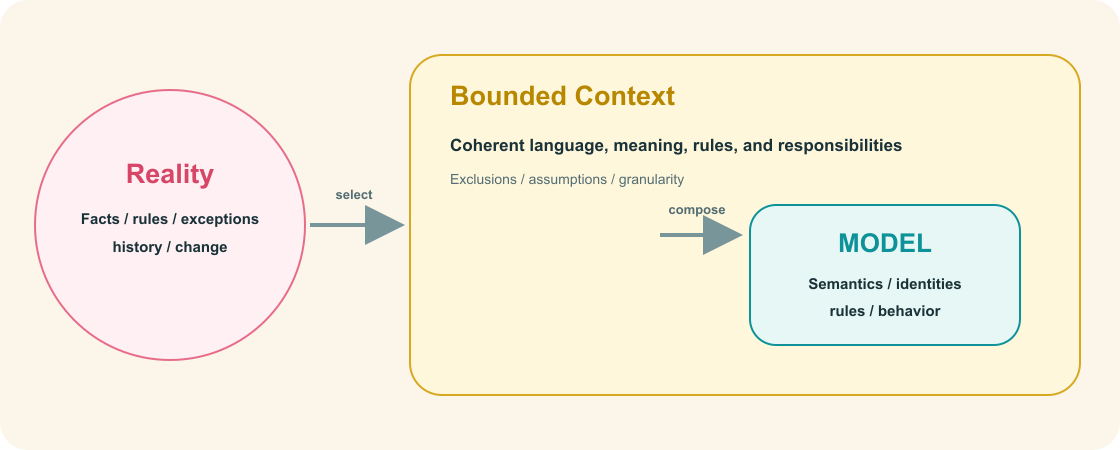
Bounded Context represents the domain-side semantic boundary. Execution Context represents the platform-side environment of runtime, resource, transaction, security, and deployment conditions under which a Model executes.
Purpose and Concern
Purpose states the decision, communication, transformation, or execution for which a model will be used. Even for the same business subject, different information is needed for a model that aligns terminology, one that validates business rules, one that implements state transitions, and one that analyzes operational failures.
A Concern is a question or interest that the model must address to fulfill its Purpose. “Who owns this rule?”, “Which state transitions are permitted?”, “What evidence supports this decision?”, and “Can processing continue during a failure?” are different Concerns. Listing Concerns makes both model content and validation conditions concrete.
Perspective and Viewpoint
A Perspective is the position and selection rule used to examine a subject. It can reflect stakeholder positions such as user, domain practitioner, developer, or operator, as well as contrasts such as present versus future, structure versus behavior, concept versus implementation, and whole versus detail.
A Viewpoint is a reusable set of conventions for repeatedly constructing, interpreting, and evaluating a kind of View. It defines the Concerns addressed, model kinds, notations, analysis methods, and consistency rules. A Perspective supplies where the subject is viewed from; a Viewpoint makes the rules for producing and reading a View reusable.
This distinction aligns with ISO 42010:2022, in which an Architecture View addresses specific Concerns and an Architecture Viewpoint establishes conventions for constructing, interpreting, and using Views. SimpleModeling extends that idea beyond Architecture to modeling activities in general.
Model Construction and the Use of Views
Constructing the Model and constructing a View have different roles. Model construction selects and transforms what a Bounded Context needs from Reality and organizes it into a structure of meanings, identities, rules, and behavior. When working with the Model, a Perspective and Viewpoint select what must be examined and expose it as a View.
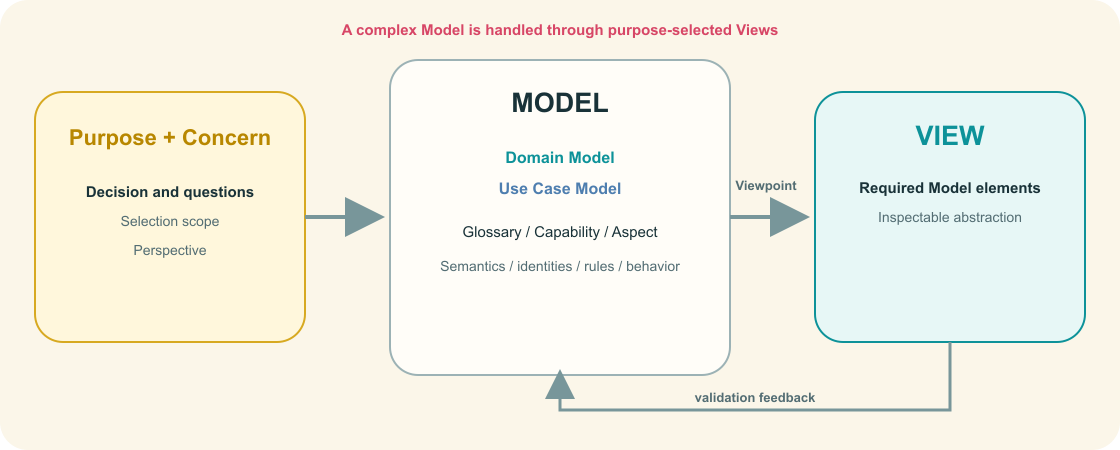
Model construction and View selection record the selected information together with exclusions, assumptions, granularity, time horizon, and selection rules. These records support evaluation of the Model boundary and the Views required for the current Purpose. Omissions and contradictions found through a View are reflected in the Model structure and the understanding of Reality as needed.
The Model Carries Required Semantics and Capabilities
A Model carries concepts, relationships, rules, constraints, and the state changes, Commands, Events, Workflows, Policies, Calculations, and Decisions required by its Bounded Context. It is used as a working abstraction connected to implementation, evaluation, knowledge, and operation.
As capabilities accumulate, the number of relationships among concepts, behavior, constraints, and qualities in the Model also increases. A diagram containing too much information makes the abstraction required for a Purpose harder to identify. Purpose- and concern-selected Views delimit the subject of examination.
Two Model Axes and Explicit Model Elements
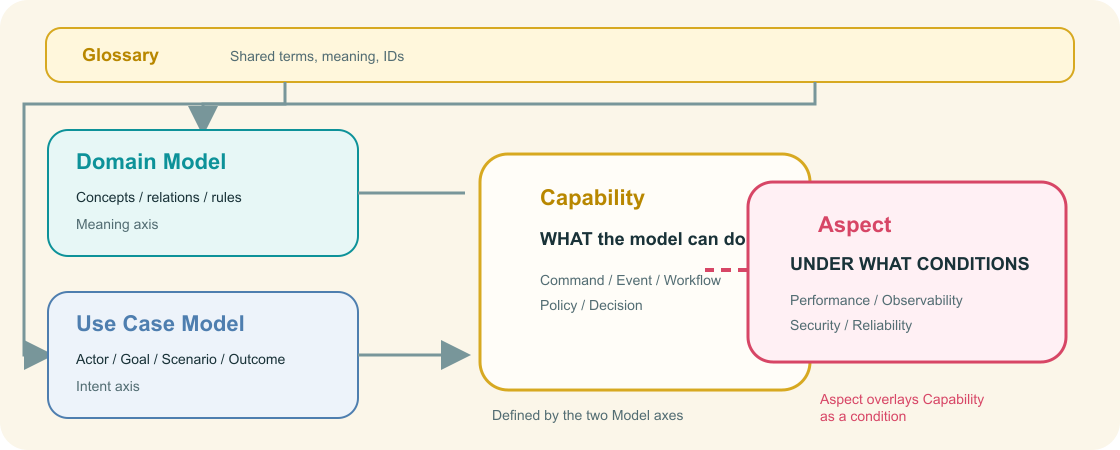
SimpleModeling treats Domain Model and Use Case Model as two axes of Model composition. The Domain Model supplies an axis of meaning through concepts, relationships, rules, and decisions; the Use Case Model supplies an axis of intent through Actors, Goals, Scenarios, and Outcomes. The two peer, orthogonal axes compose and examine elements of the same Model from different directions. This article centers the Object Model in the explanation to make formal structure concrete and clarify continuity with UP.
The two axes compose Capability and Aspect as explicit Model elements. A Capability states what the Model can do and organizes Commands, Events, Workflows, Policies, Decisions, and related behavior into one identifiable unit. An Aspect states the conditions under which that Capability holds and overlays quality conditions such as Performance, Observability, Security, and Reliability. As conditions on a Capability, Aspects are designed and evaluated together with that Capability.
Glossary as the Semantic and Identity Backbone
A Glossary manages the names, meanings, boundaries, synonyms, and identifiers of the Ubiquitous Language and supplies the same vocabulary and IDs to both the Domain Model and Use Case Model. This vocabulary and these IDs trace conceptual identity across narrative text, formal Model elements, multiple Views, tests, and implementation.
Views Make a Complex Model Usable
A View is an inspectable representation used to extract the elements, relationships, behavior, and qualities required by a Purpose and set of Concerns when understanding, evaluating, or applying a complex Model. Diagrams, prose, tables, CML, glossaries, Knowledge Graphs, and execution traces can serve as its representation. The meaning and identity of a View refer to the Model and Glossary.
Domain View as a Semantic Reference
A Domain View exposes the Ubiquitous Language, concepts, relationships, rules, and boundaries required by a Purpose from the Domain Model meaning axis. It serves as a semantic reference among Views by mapping Actors, Goals, Capabilities, states, Events, and quality-related subjects to the same elements of the Model.
Use Case and Quality-Attribute Views
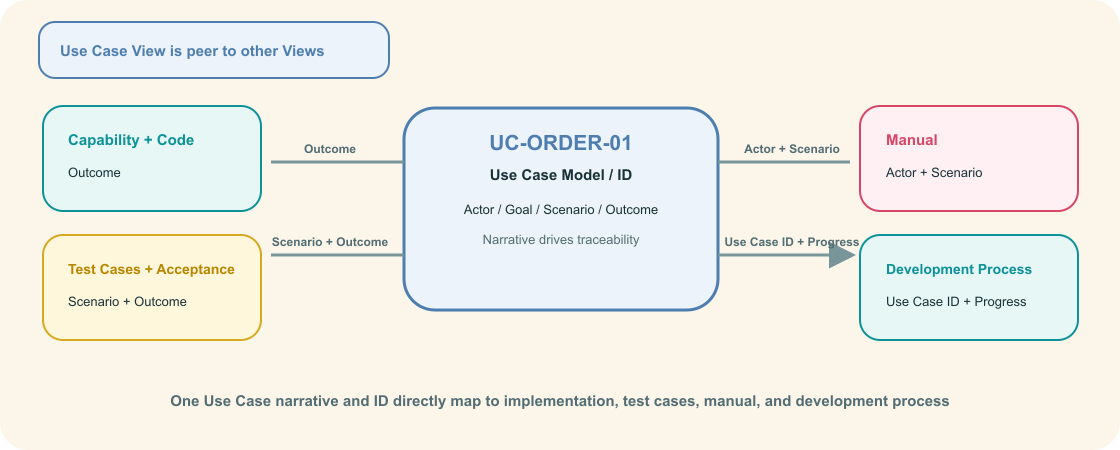
A Use Case View follows an Actor’s Goal through Scenarios and connects the Capabilities supplied by the Model to observable Outcomes and exceptions. The Domain View shows what subjects mean, while the Use Case View shows for whom an outcome is achieved and how Model capabilities are used. The Use Case View is positioned as a peer of the other Views.
Quality-attribute Views expose cross-cutting conditions such as Reliability, Performance, Security, Operability, Observability, and Evolvability, organized by Concern. They overlay the Domain and Use Case Views to examine the load, failure, authorization, operational, and change conditions under which Capabilities remain effective.
Use Case Model as Development Traceability
The connection between a Use Case View and the wider development process is established by the information structure of its underlying Use Case Model. A Use Case Model preserves Actors, Goals, Scenarios, and Outcomes as one narrative with a Use Case ID. Outcomes map to Capabilities and implementation, Scenarios and Outcomes to acceptance criteria and test cases, Actors and Scenarios to manuals, and the Use Case ID to development-process work units and progress management.
For example, an order-confirmation narrative identified as UC-ORDER-01 connects its natural-language Goal and Scenarios to Capability, Code, Acceptance, Test, Manual, and Development Process artifacts. These mappings provide an axis for tracing changes across development. The Use Case Model supports both requirements explanation and direct mapping from narrative to implementation artifacts.
A Purpose-Selected View Catalog
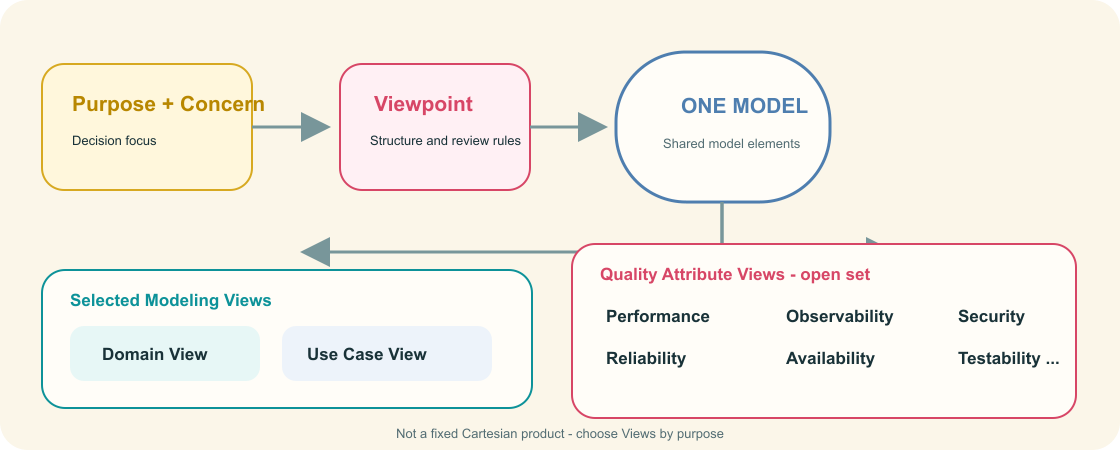
A View Catalog is an open set that expands according to the purposes for examining a Model. In addition to Domain and Use Case Views, it can register quality-attribute Views such as Performance, Observability, Security, Reliability, Availability, and Testability. Purpose and Concerns select the required Viewpoint, whose conventions construct the View from the Model.
Views are constructed by selecting those required by the Purpose. For View Groups and Viewpoints, only the required intersections are materialized as Views.
UP 4+1 View Groups and the SimpleModeling Extension
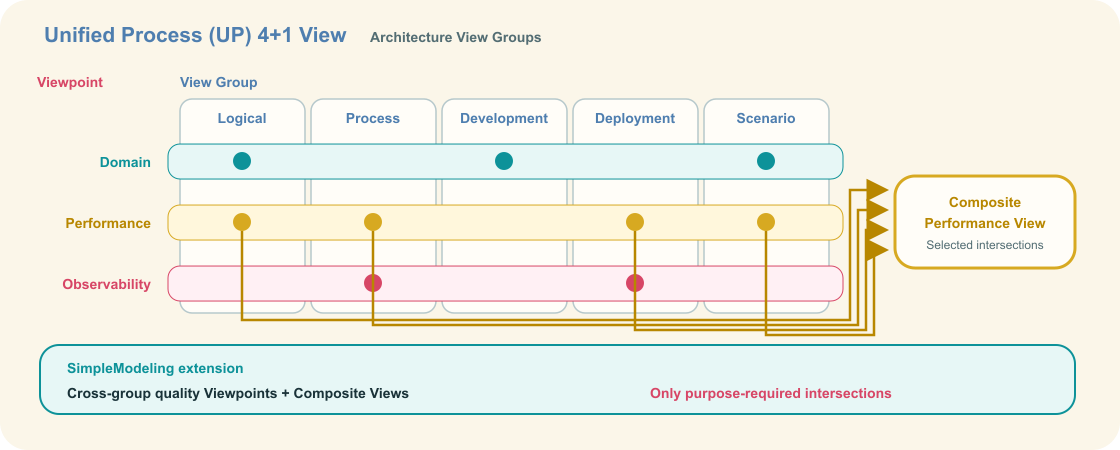
SimpleModeling is built on the UP (Unified Process) and inherits its 4+1 Views—Logical, Process, Development, Deployment, and Scenario—as five selectable Architecture View Groups. A View Group is a family of architectural concerns; the concrete Views within each Group are selected according to Purpose.
The SimpleModeling extension is that Viewpoints such as Domain, Performance, and Observability can cut across multiple View Groups. A Performance Viewpoint can, for example, construct the purpose-required Performance Views of the Logical, Process, Deployment, or other Groups and combine them as a Composite Performance View. This preserves the UP structure while extending it into a View System that traces Domain and quality-attribute Concerns across Groups.
Multiple Views and Correspondence
Domain, Use Case, Application, and quality-attribute Views can be composed as complementary Views of the same Model. A Domain View emphasizes problem-domain meaning, structure, rules, and boundaries, while an Application View emphasizes Use Case realization, Collaborations, Interactions, state transitions, Events, Services, and Operations. Each addresses different Concerns.
Concepts, boundaries, rules, and identifiers shared by multiple Views have explicit correspondences. A Glossary connects names and meanings, while mappings and reference links identify relationships among Model elements. Items without a correspondence identify areas for re-examining the understanding of Reality, View-selection conditions, or Model representation.
ConfirmOrder through Selected Views
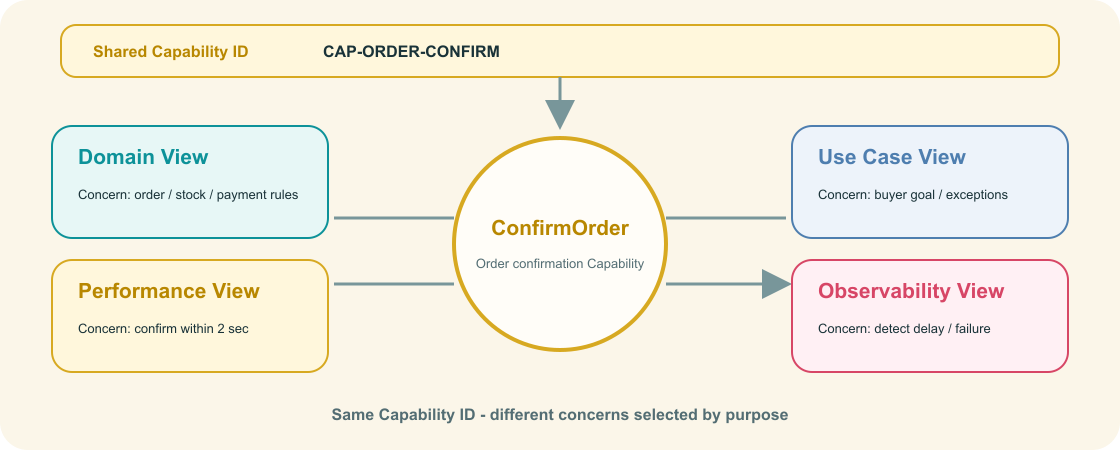
Consider an order-confirmation Capability with the Glossary-managed shared Capability ID CAP-ORDER-CONFIRM . A Domain View examines order, stock, and payment rules; a Use Case View examines the buyer’s Goal and exceptions; a Performance View examines the two-second condition; and an Observability View examines detection of delays and failures.
Each View exposes a different Concern and maps to one order-confirmation Capability through the shared Capability ID. Following this ID confirms that the purpose-selected Views address the same Capability from different aspects.
Four Kinds of Quality
SimpleModeling evaluates the quality of Models and Views using four criteria: Clarity, Consistency, Validity, and Accuracy.
| Quality | Question |
|---|---|
|
Clarity |
Can people and AI interpret it with the same meaning? |
|
Consistency |
Do definitions and relationships avoid conflict within and across Views? |
|
Validity |
Does it address the Concerns required by its Purpose? |
|
Accuracy |
Do facts and rules within the selected scope agree with Reality? |
Tools and AI can broadly support checks for clarity and consistency. Validity and accuracy require users who hold the Purpose, domain experts, observations, and execution results. SimpleModeling distinguishes making structures precise from guaranteeing correctness with respect to Reality.
These four qualities are criteria for evaluating Models and Views. Quality-attribute Views expose properties such as Reliability and Security that the Model must realize. Evaluation criteria and the quality attributes being visualized have separate roles.
An Iterative Modeling Loop
Models and Views are updated iteratively. Reality is distilled into a Model according to the Purpose and Concerns of a Bounded Context; Views are constructed according to Perspectives and Viewpoints; and scenarios, reviews, tests, and execution results evaluate them. Omissions and contradictions are reflected in the Views, Model, Bounded Context boundary, Concerns, View-selection rules, and the understanding of Reality.
Through this loop, a Model functions as a working abstraction updated by knowledge and execution results.
Three Constituent Models and the Realization Path
Part 4 takes the Model as its subject and centers the Object Model when explaining formal structure. The later section organizes the three SimpleModeling Model constituents, the purpose-specific Domain, Use Case, and Application Models built from them, and the realization path.
| Constituent Model | Primary purpose |
|---|---|
|
Holds Objects, types, responsibilities, relationships, constraints, state, and behavior as formal structure. |
|
|
Knowledge Model |
Holds evidence, sources, semantic relationships, and discovery paths as knowledge structure. |
|
Literate Model |
Holds context, intent, explanation, Goals, and Scenarios through narrative and structured elements. |
Domain Modeling organizes the meaning, structure, rules, and boundaries required by a Purpose and set of Concerns from the three constituents as a Domain Model. Use Case Modeling organizes Actors, Goals, Scenarios, and Outcomes as a Use Case Model. Application Modeling organizes the dynamic structures needed for Use Case realization as an Application Model. Shared Object Model elements and Glossary IDs map these applied Models and their Views to each other.
Application Modeling constructs a Use Case Realization Model from a Use Case Scenario in the Literate Model and maps it through Collaborations and Interactions to StateMachines, Events, Services, and Operations. Domain Modeling emphasizes static aspects and Application Modeling emphasizes dynamic aspects, but they are not treated as completely exclusive categories.
Model Realization connects approved executable formal structures to CML, implementation, tests, and runtime environments. Gaps found in reviews, tests, and execution are reflected in Object-centered structures, Knowledge Model evidence, Literate Model context and intent, the Bounded Context, the Application Model, and View selection.
Working with Models and Views through AI
AI infers unspecified Purpose, Concerns, Perspective, and granularity from a request. Users state these selection conditions and compare them with those applied by the AI. Generated results are reviewed together with the question that each View was constructed to address.
When the Bounded Context, Purpose, Concerns, Perspective, Viewpoint, exclusions, and requested View are explicit, AI can explore the Model under those selection conditions and present candidate abstractions and correspondences as a View. People review the validity of the selection for the Purpose and its accuracy with respect to Reality. The review covers the generated result, the Model of the referenced Bounded Context, and the constructed View.
AI Connects Narrative Models to Implementation
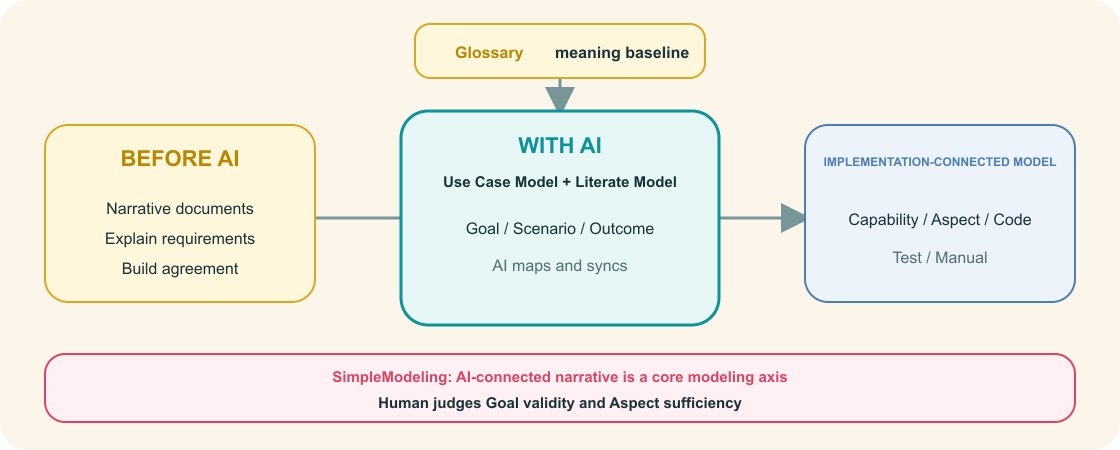
Before AI, Use Case and Literate Models were used to explain requirements, design intent, and assumptions in natural language and to establish stakeholder agreement. People performed most mappings from narrative to Model elements, implementation, tests, and manuals, as well as the synchronization of subsequent changes.
Using Glossary meanings and identifiers as a baseline, AI can map Goals, Scenarios, and Outcomes to Capability, Aspect, Code, Test, and Manual artifacts, then find and synchronize related artifacts when changes occur. Through these connections, Use Case and Literate Models can serve as development Models synchronized with implementation artifacts in addition to supporting explanation and agreement. SimpleModeling treats this AI-connected narrative as one axis of the methodology.
AI supports mapping, consistency checks, and the presentation of change candidates. People judge the validity of a Goal for the business Purpose, the sufficiency of Aspects as conditions on a Capability, the Purpose itself, and accuracy.
Methodological Design Decisions
| Decision | Meaning |
|---|---|
|
Separate Reality and model |
Treat a Model as an abstraction of Reality whose selections and omissions can be explained. |
|
Use Bounded Context as the semantic boundary |
Define what is distilled from Reality through coherent domain language, meaning, and rules, distinct from the platform-side Execution Context. |
|
Start with Purpose and Concerns |
Define intended use and questions before notation or technology. |
|
Distinguish the structure held by the Model from the information selected into a View for a Purpose. |
|
|
Allow multiple Views |
Treat Views for different Concerns as complementary and map shared concepts. |
|
Use the Domain View as a semantic reference |
Use the Domain View and Glossary to map multiple Views to the meanings and identities of the same Model. |
|
Compose purpose-specific applied Models from three constituents |
Compose Domain, Use Case, and Application Models from Object, Knowledge, and Literate contributions. Domain and Use Case Models organize meaning and intent, while the Application Model organizes the dynamic structures needed for Use Case realization. Use the Object Model to explain formal structure. |
|
Inherit and extend UP 4+1 |
Preserve the five View Groups and add cross-group Viewpoints, purpose-required intersections, and Composite Views. |
|
Place the Use Case View as a peer of the other Views and directly map the Use Case Model narrative and ID to implementation, tests, manuals, and process work. |
|
|
Treat AI-connected narrative as a core axis |
Map Use Case and Literate Models to implementation artifacts and synchronize change while retaining human judgment over Goals and Aspects. |
|
Separate model qualities |
Evaluate clarity and consistency separately from validity and accuracy. |
|
Iterate through evidence |
Return reviews, tests, and execution results to Models and selection conditions. |
Next
This article organized Model structure and the use of Views, using the Object Model as the center of the formal-structure explanation. Purpose-specific Domain, Use Case, and Application Models are composed from Object, Knowledge, and Literate contributions, and the complex Model is handled through Views that inherit and extend UP 4+1. Application Modeling organizes dynamic Use Case realization, while Model Realization connects approved Models to implementation and execution. The next article examines the Object Modeling techniques of Objects, Types, Constraints, responsibilities, and Collaborations.
References
Glossary
- Model
-
A Model is an abstraction that represents a subject according to a particular Purpose and Concern so that it can be understood, reasoned about, evaluated, or constructed. It is not the subject itself; it preserves the elements, relationships, and meanings required for its purpose.
- Object Model
-
Undefined
- UP (Unified Process)
-
A process model based on UML, characterized by iterative, use-case–driven, and architecture-centric development. It has derivatives such as the Rational Unified Process (RUP) and provides a foundation for practicing Component-Based Development (CBD).
- Use Case
-
In UML, a Use Case is a Model Element that specifies a set of Actions performed by a subject to yield an observable result of value to an Actor or other stakeholder.
- Behavior
-
In UML, Behavior is a specification of how its context Behaviored Classifier changes State over time. It may define possible executions, emergent Behavior, or a selected example of execution.
- View
-
A View is a representation that projects selected parts of a Model according to a particular Purpose and Concern so they can be understood, reasoned about, evaluated, or used. A View presents part of a Model and does not own meaning independently of the source Model.
- Aspect
-
An Aspect is a condition, property, or Concern examined across multiple Model Elements or behaviors. It centers on Quality Attributes and may include cross-cutting conditions that are not adequately expressed by a Quality Attribute alone.
- Capability
-
A Capability describes what a Model or system makes possible for a user or problem domain. It focuses on the result or function provided rather than prescribing how it is realized.
- Object
-
An Object is an Instance classified by a Class or another Classifier and may have structure, State, and Behavior. It is treated as an individual that can be referred to separately from other Instances of the same Classifier.
- Realization
-
Undefined
- Application Modeling
-
Application Modeling is the activity of concretizing Use Cases as application behavior and constructing an Application Model. It clarifies the mappings from Use Case Scenarios to participants, Roles, responsibilities, Collaborations, Interactions, state transitions, Events, Services, and Operations.
- State
-
In UML, a State models a situation during which an invariant condition holds. The current State of an Object may determine accepted Events and Operations, applicable Constraints, and possible next Transitions.
- Responsibility
-
A Responsibility is an obligation stating what an Object or Role must know, decide, perform, or protect. It assigns ownership of rules and Behavior, not merely structural information.
- validation
-
Validation is the activity of confirming that a system or product fulfills its intended use and stakeholder requirements.
- SimpleModeling
-
SimpleModeling is a modeling-centered software development methodology and technology system for constructing a Domain Model from Knowledge, formalizing it in CML, realizing it as executable software through Cozy and AI, and running it on Textus.
- Identifier
-
An Identifier is a value used to refer to a subject with Identity or to a correlation subject and distinguish it from others. An Identifier may represent Identity, but it is not itself the meaning by which the subject remains the same over time.
- Event
-
In UML, an Event describes an occurrence that may arise during the execution of Behavior. Receiving an Event occurrence may trigger Behavior such as a Transition in a StateMachine.
- Constraint
-
In UML, a Constraint is a condition or restriction expressed in natural language or a machine-readable language to declare part of the Semantics of one or more Model Elements. Its evaluation yields a Boolean value and has no side effects.
- Security
-
Security is the quality of protecting information and functions according to legitimate authority and preventing unauthorized disclosure, use, modification, destruction, or repudiation. It includes Concerns such as Confidentiality, Integrity, Authenticity, and Accountability.
- Reliability
-
Reliability is the quality by which a system consistently performs required functions under specified conditions for a specified period. It is evaluated through concerns including Availability, Fault Tolerance, and Recoverability.
- Performance
-
Performance is the quality by which a system satisfies timing requirements such as processing time, response time, Throughput, and capacity under specified conditions and resources.
- Test
-
A Test is an activity and specification that executes or evaluates a subject under stated conditions and compares observed results with expected results or Constraints to check conformance to requirements or contracts.
- Glossary
-
A Glossary is a knowledge resource that manages the names, meanings, boundaries, synonyms, and identifiers of terms used in a subject domain. It provides a common foundation for participants to use the same terms with the same meanings.
- Identity
-
Identity is the sameness by which a subject is distinguished from others and tracked as the same subject over time even when its values or State change. An Identifier is a value that represents or refers to Identity; it is not the Identity itself.
- CML (Cozy Modeling Language)
-
CML (Cozy Modeling Language) is the SimpleModeling formal modeling language for describing the Executable Model portion of an Object Model that connects to program generation and execution.
- defect
-
An imperfection or deficiency in a work product (designs, specifications, code, etc.). It does not meet requirements or specifications and requires repair or replacement. Defined in ISO/IEC 24765.
- Development Process
-
Undefined
- Quality Attribute
-
A Quality Attribute is a characteristic that expresses the degree of quality with which software satisfies requirements in addition to performing its functions. Examples include Security, Performance, Availability, Reliability, Resilience, Observability, and Maintainability.
- Collaboration
-
In UML, a Collaboration is a Classifier describing a structure of participant Roles that perform specialized functions and collectively accomplish desired functionality.
- Operation
-
In UML, an Operation is a Behavioral Feature of a Classifier that specifies the name, type, Parameters, and Constraints for invoking associated Behavior. The Operation specifies an invocation contract, while a Method or another Behavior realizes it.
- Type
-
Undefined
- Literate Model
-
Undefined
- Domain Modeling
-
Undefined
- Use Case Modeling
-
Use Case Modeling is the activity of constructing a Use Case Model of user and external-party intent toward a system using Actors, Goals, Use Cases, Scenarios, and Outcomes.
- Use Case Scenario
-
Undefined
- Interaction
-
Undefined
- StateMachine
-
In UML, a StateMachine is a Behavior that expresses the event-driven Behavior of a system element by traversing a graph of States through Transitions triggered by Event occurrences.
- Activity
-
A concrete action or task performed within an Activity Space to move an Alpha to a more advanced state, typically producing or refining Work Products.
- Traceability
-
Development Traceability is the property of being able to follow relationships among requirements, terms, Model Elements, design decisions, Tests, implementation, and execution results through identifiers and evidence.