Meta Development System Framework
To establish a cyclical development environment driven by Literate Modeling, Knowledge, and AI Assistance, SimpleModeling proposes a meta-level process that defines development itself. The Meta Development System Framework stands at the center of this concept as a higher-level model, providing the theoretical foundation for designing and improving development processes used in projects. This framework integratively defines both the development targets (model, architecture, platform) and the ways of working (process, style, approach).
Meta Development System Framework
SimpleModeling places the development system—a cyclical environment integrating Literate Modeling, Knowledge-Driven, and AI-Assisted approaches—at the core of development.
This framework integratively defines both the development targets (model, architecture, platform) and the ways of working (process, style, approach).
Within SimpleModeling, the Meta Development System Framework is being defined as a higher-level concept for systematically constructing and reusing development systems.
This framework represents a meta-level process that designs and defines development activities themselves, specifying “how to design, operate, and improve the development system.”
Development System Framework
The SimpleModeling meta-development process framework has the following structure.
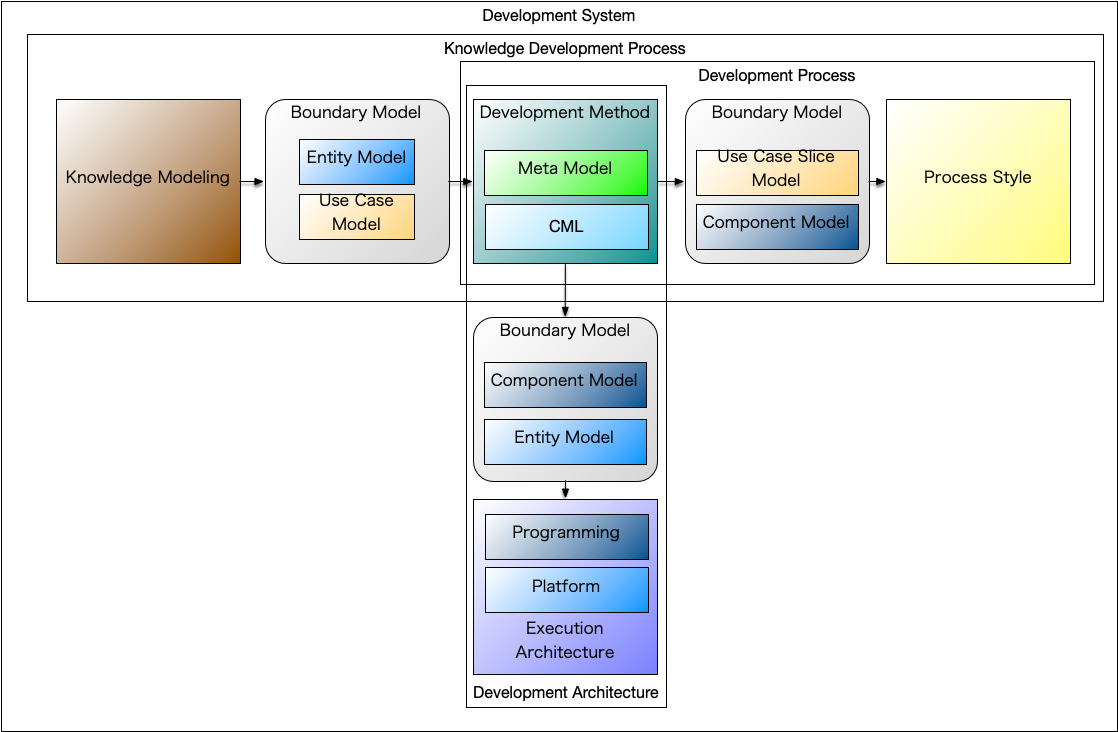
To generate a Development System Framework from the Meta Development System Framework, the development method is connected to the following three processes.
By connecting the process style to the development method, the development process is defined.
Knowledge modeling extends traditional business modeling in software development for knowledge-driven development, representing the outcomes of business modeling as structured knowledge models.
By connecting the development process with knowledge modeling, a knowledge development process is defined.
Furthermore, by linking the development method to the execution architecture, the development architecture is defined.
The integration of the development process, knowledge development process, and development architecture constitutes the Development System Framework.
Development System Reference Profile
From the Meta Development System Framework, a purpose-specific Development System Framework is created, from which a project-specific development system is defined and customized. However, performing such customization work for every individual project is not practical.
Therefore, reference profiles are defined and provided for typical configuration patterns of development systems.
Project Development System
Typically, the project development system is created by fine-tuning an existing Development System Reference Profile.
Since the Development System Framework provides a broad range of generic functions, disabling unnecessary ones becomes an important aspect of customization.
On top of that, project-specific requirements are incorporated and refined accordingly.
Operation of the Meta Development System Framework
The Meta Development System Framework operates as a four-layer structure that is progressively concretized from higher to lower levels.
These layers are deployed through the following steps:
-
Concretize the Meta Development System Framework and define the Development System Framework.
-
Define representative configurations as reference profiles.
-
Adjust the reference profile for each project to form a project-specific development system.
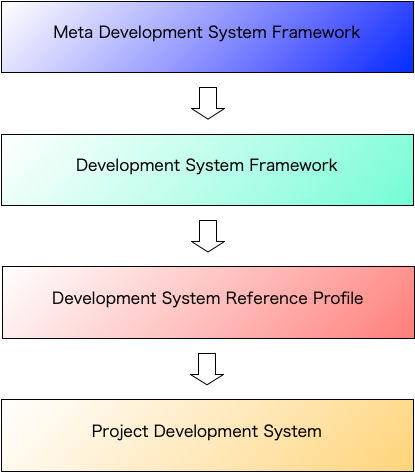
The Development System Framework is formed by incorporating knowledge modeling, process style, and execution architecture into the Meta Development System Framework. It systematizes the flow of development, roles, deliverables, and rules, with specific process models such as RUP and Scrum serving as typical examples.
The Project Development System is a customized version of the Development System Framework, adapted to the specific conditions of a development project.
At this stage, it is assumed that a Development System Reference Profile will be used for convenience.
Development activities at the project site are then carried out using this Project Development System.
Structure of the Meta Development Process Framework
The development system defines the following three frameworks around the core of the development method.
Development Process
The development process is a framework that defines “how development proceeds.” It models the areas of work, activities, work products, roles, and their interrelationships within the development lifecycle.
As described later, the development system will be expressed using OMG Essence, where the development process is represented through the relationships among alphas, activity spaces, and work products that guide project progression.
Each activity space represents a domain of activity that advances the state of a specific alpha, producing work products as its outputs.
In SimpleModeling, the development process is characterized by a process style, enabling unified representation of diverse styles such as Waterfall, Agile, Model-Driven, and AI-Assisted development.
Development Architecture
The development architecture defines “how the development is structurally supported.” It systematically designs the technical foundation, execution platform, and component configuration that support the project, operating them in coordination with the development process.
The development architecture in SimpleModeling follows the principle of Model–Platform Separation, clearly distinguishing between the abstract layer centered on the domain model and the execution layer built on technologies such as Scala, TypeScript, CDK, and ECS.
This separation enables AI to accurately interpret the context when bridging the two layers, enhancing the precision of AI-based code generation and completion.
Knowledge Development Process
The Knowledge Development Process connects knowledge modeling as an upper layer above the traditional software development process.
Knowledge modeling extends business modeling for knowledge-driven development, accumulating the outcomes of business modeling as structured knowledge.
In the Generative AI Reference Architecture introduced in 📄 AI Collaboration Architecture, knowledge accumulation takes place through the following two mechanisms within AI processing.
-
Knowledge Circulation
Knowledge promotion is a mechanism on the AI side, while knowledge circulation is the process of reintegrating AI-generated outputs back into the Body of Knowledge (BoK), an activity that can be managed within the knowledge development process.
By formalizing this activity as part of the Knowledge Development Process, the integration between the development process and knowledge modeling is reinforced.
Boundary Model
The development method connects with external processes through boundary models.
A boundary model is based on the object-function model defined by the development method and clarifies the logical connection points for input and output between external processes.
-
Input Boundary Model from Knowledge Modeling
-
Output Boundary Model for Process Style
-
Output Boundary Model for Execution Architecture
The linkage from knowledge modeling involves creating an input boundary model for the development method from the outputs of knowledge modeling and using that model as input when executing the development method.
As a result of executing the development method, output boundary models are produced for both the process style and execution architecture. Each of these components performs its respective operations using the boundary model as input.
Description Method of the Development System
The definition of the development system is planned to be described using OMG Essence. By expressing the development system’s reference profile in Essence, it is expected that tuning toward each project development system will become easier and more systematic.
Essence is used in the case study explained in sessions 40 through 47 of 📄 Object-Oriented Analysis and Design Course for Cloud Applications. The development system of the reference profile is expected to be an extension of the one introduced in these lectures.
Perspective
The ultimate goal of the Meta Development System Framework is to realize a self-improving development method. By allowing AI to analyze project outcomes, histories, and model changes to propose improvements for subsequent development, it aims to establish a mechanism in which the development process itself learns and evolves.
While this represents a long-term vision, in the near term, a concrete development process is needed as a foundation for both conceptual discussions and practical implementation of Literate Model-Driven Development (and Knowledge-Driven Development). The Meta Development System Framework serves as the theoretical foundation for this process.
As an initial step, a SimpleModeling Reference Profile—a development system reference profile for concretizing technical explanations on SimpleModeling.org—will be established and used as the foundation for further elaboration.
Building upon this, discussions on higher layers such as the Development System Framework and the Meta Development System Framework will be conducted as needed.
References
Glossary
- Literate Modeling
-
Undefined
- SimpleModeling
-
SimpleModeling is a modeling-centered software development methodology and technology system for constructing a Domain Model from Knowledge, formalizing it in CML, realizing it as executable software through Cozy and AI, and running it on Textus.
- Meta Development System Framework
-
A meta-level framework that defines and designs development activities themselves. It integrates methods, processes, and architectures to build a cyclic, AI-assisted development environment.
- Development Process
-
Undefined
- Development System Framework
-
A standard structure of a development system materialized from the Meta Development System Framework. It connects the development method with Knowledge Modeling, Process Style, and Execution Architecture.
- Development Method
-
Undefined
- Knowledge Modeling
-
Undefined
- Process Style
-
Undefined
- Execution Architecture
-
A technical and runtime foundation supporting the development system, separating model and execution layers.
- Knowledge Development Process
-
A process connecting Knowledge Modeling with software development, integrating knowledge elevation and knowledge circulation via AI.
- Development Architecture
-
A structural foundation defining how development is supported through technology, platform, and components.
- Project Development System
-
A customized implementation of the development system for each project, derived from the reference profile.
- Development System Reference Profile
-
A reference profile that templates typical development system configurations. It provides reusable baselines for customizing project-specific systems.
- Operation
-
In UML, an Operation is a Behavioral Feature of a Classifier that specifies the name, type, Parameters, and Constraints for invoking associated Behavior. The Operation specifies an invocation contract, while a Method or another Behavior realizes it.
- Activity
-
A concrete action or task performed within an Activity Space to move an Alpha to a more advanced state, typically producing or refining Work Products.
- Alpha
-
A key progress dimension in Essence representing an essential element of software engineering (e.g., Opportunity, Stakeholders, Requirements, Software System, Team, Work, Way of Working). Each Alpha evolves through well-defined states.
- OMG Essence
-
An OMG standard meta-model that captures the essentials of software engineering practices. It defines the core concepts (Alphas, Activity Spaces, Work Products) used to describe and improve development methods and processes.
- Work Product
-
A tangible result or artifact produced by activities to provide evidence of an Alpha’s state. Examples include documents, models, code, or other verifiable outputs.
- Activity Space
-
A conceptual area of work in Essence where related activities are performed to advance one or more Alphas. Each Activity Space groups Activities with a shared objective.
- State
-
In UML, a State models a situation during which an invariant condition holds. The current State of an Object may determine accepted Events and Operations, applicable Constraints, and possible next Transitions.
- Feature
-
In UML, a Feature is a structural or behavioral characteristic of Instances of a Classifier. Features include Structural Features such as Attributes and Behavioral Features such as Operations.
- Model
-
A Model is an abstraction that represents a subject according to a particular Purpose and Concern so that it can be understood, reasoned about, evaluated, or constructed. It is not the subject itself; it preserves the elements, relationships, and meanings required for its purpose.
- Platform
-
A Platform is a shared set of technical foundations and services used to build, deploy, execute, and operate software.
- Scala
-
Undefined
- Generative AI Reference Architecture
-
An architecture that organizes the internal processes executed by generative AI: knowledge activation, assimilation, expression, promotion, and circulation.
- Knowledge Promotion
-
A long-term integration process in which structured knowledge from the BoK is permanently incorporated into the model’s Pretrained Parametric Knowledge (PPK) through retraining or fine-tuning.
- knowledge circulation
-
Knowledge Circulation denotes the cyclical process in which knowledge is activated, assimilated, expressed, and promoted between AI and humans, then re-activated. Through this loop, knowledge generated by AI is organized and reintegrated into the SmartDox site or BoK (Body of Knowledge), allowing the whole system to evolve and deepen AI’s understanding and generative ability.
- BoK (Body of Knowledge)
-
At SimpleModeling, the core knowledge system for contextual sharing is called the BoK (Body of Knowledge). The goal of building a BoK is to enable knowledge sharing, education, AI support, automation, and decision-making assistance.
- Boundary Model
-
A Boundary Model defines the logical connection structure through which information and deliverables are exchanged across different processes or layers—such as knowledge modeling, process style, and execution architecture. It bridges the internal and external aspects of a development method, clarifying inputs, outputs, and dependencies.
- Knowledge-Driven Development
-
A development paradigm that centers on knowledge, integrating AI assistance and modeling for continuous evolution.
- Literate Model-Driven Development (LMDD)
-
Literate Model–Driven Development (LMDD) is a software development methodology that integrates natural-language narrative and formal model structure within a unified text-based framework. It extends conventional Model–Driven Development (MDD) by treating documentation and models as a single, consistent source of truth. In LMDD, the descriptive and structural elements of development artifacts are expressed together using the SmartDox language. From this unified representation, ModelDox extracts structural data, CML (Cozy Modeling Language) defines domain-specific models, and Cozy generates executable code, documentation, and configuration artifacts. Artificial intelligence participates in the LMDD process by analyzing the narrative context, validating structural consistency, and supporting the refinement of models and generated artifacts. All artifacts are represented in text form, ensuring traceability, version control, and interoperability within standard development environments. By defining a formally connected and machine-interpretable relationship between documentation, design, and implementation, LMDD provides a foundation for AI-assisted model–driven engineering where human authorship and automated reasoning operate on the same representational layer.
- SimpleModeling Reference Profile (SMRP)
-
This is the reference profile of SimpleModeling. To concretely illustrate Literate Model-Driven Development with SimpleModeling, a reference profile is defined.