AI Collaboration Architecture
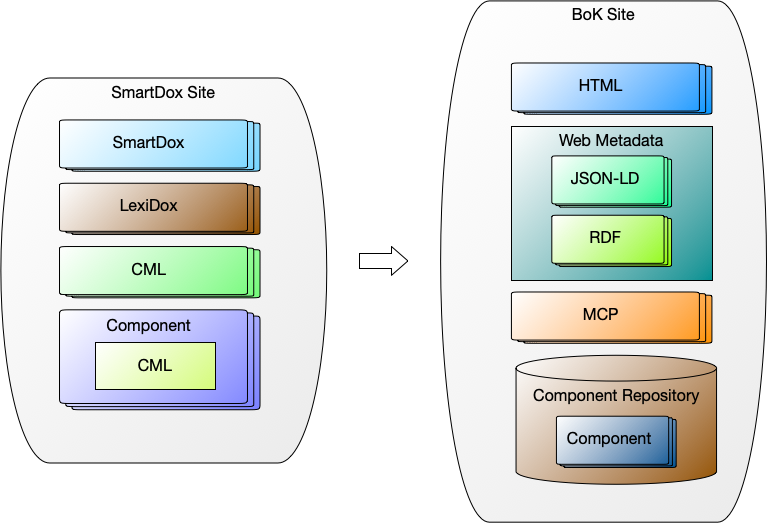
The SmartDox site structures knowledge and serves as the foundation for a continuous learning cycle in which AI can understand and learn from it. To enable both humans and AI to share the knowledge described in the SmartDox site and internalize it as the AI’s tacit knowledge, we designed the BoK (Body of Knowledge) (Body of Knowledge). This article explains the composition of both the SmartDox site and the BoK, as well as the BoK generation architecture that connects them.
SmartDox Site
The SmartDox Site is composed of a collection of SmartDox documents organized as a structured knowledge space. Each document is systematically arranged within directory hierarchies, forming an interlinked network of knowledge.
Currently, there are three kinds of SmartDox documents:
-
SmartDox: Describes general articles and explanations. - LoxiDox: Defines terms listed in the glossary. - CML: Defines object information models. A general SmartDox document describes domain knowledge—concepts, rules, and constraints—related to its subject domain.
SmartDox also serves as a metalanguage for DSLs, enabling consistent expression of conceptual and structural knowledge.
Two literate DSLs are built upon this metalanguage: LoxiDox for terminology definitions, and CML for domain model specifications. Both are themselves SmartDox documents and can be transformed into BoK artifacts using the SmartDox command.
SmartDox automatically generates a glossary from LoxiDox terms and builds cross-references linking articles to glossary entries. Through this mechanism, the site becomes a navigable and semantically connected knowledge system.
A CML document defines a domain model operable by software, using entities, state machines, and behavioral specifications. It serves as the foundation for code generation and model-driven application design.
| Type | Content | Output | Remarks |
|---|---|---|---|
|
SmartDox |
Explanation / Design / Theory |
HTML / Web Metadata |
Readable and indexable knowledge representation |
|
LoxiDox |
Glossary Terms |
HTML / Web Metadata |
Knowledge representation of domain terms |
|
HTML / MCP / Web Metadata |
Foundation for model definition and behavioral specification |
Structure of BoK
The SmartDox command analyzes the entire SmartDox site, generates structured HTML and semantic metadata from all documents, and additionally produces MCP (Model Context Protocol) definitions from CML documents. The integration of these outputs constitutes the BoK.
| Output Layer | Main Format | Content and Role | Primary Consumers |
|---|---|---|---|
|
JSON / YAML |
Defines operational and executable interfaces for models and entities, enabling actions by AI and tools. |
AI / Agent |
|
|
HTML |
HTML5 |
Generates a structured, interpretable representation of SmartDox documents for both humans and AI. |
Human / AI |
|
Web Metadata |
JSON-LD / RDF |
Semantically links and classifies SmartDox documents, integrating them into a learnable knowledge graph as the BoK. |
AI / Search System |
The BoK generated in this way serves as a foundation for AI collaboration and knowledge assimilation, integrating documents, models, and semantic information into a unified knowledge base.
Furthermore, components generated from CML are registered in the BoK as component assets. In this case, the BoK also functions as a component repository.
BoK Generation
To generate a BoK from a SmartDox site, each type of resource stored within the SmartDox site is transformed into corresponding BoK components.
The following diagram illustrates how SmartDox resources are converted into BoK resources.
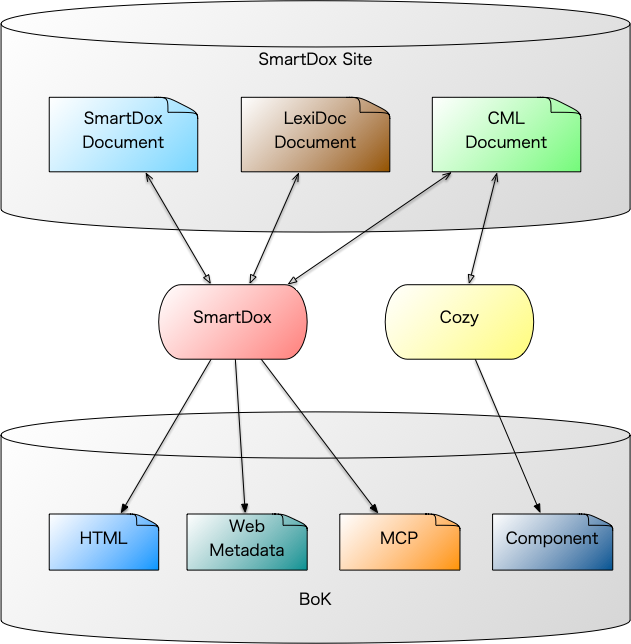
SmartDox documents are converted into HTML documents and Web metadata by the SmartDox command. At present, the Web metadata is generated in JSON-LD format and embedded directly within the HTML documents.
Since CML documents are also a kind of SmartDox document, they are likewise transformed into HTML documents and Web metadata by the SmartDox command.
In addition, because CML documents possess software-oriented characteristics, they also generate MCP definitions. Through the MCP, behavioral information of the domain knowledge described in the BoK is conveyed to generative AI systems via RAG (Retrieval-Augmented Generation).
Beyond article and term generation handled by the SmartDox command, CML documents are also processed by the Cozy command to automatically generate programs. These generated programs are packaged as components and reused as building blocks in applications.
Example
The following section illustrates a concrete example of the Web metadata stored within the BoK.
Here is an entity model described in CML. We will then examine the corresponding MCP and JSON-LD representations derived from this information.
# Entity
## Person
This entity represents a person. It serves as a basic unit for identifying users, operators, or staff members within an application. It holds personal information such as identifiers, names, and ages.
### Attributep
| name    | type       | mul | description |
|---------+------------+-----+--------------------------------|
| id      | identifier | 1   | A unique identifier assigned within the system |
| name    | name       | 1   | The person's full name |
| age     | age        | ?   | Age, an optional attribute |
### Rule
1. The id must be unique.
2. The name must not be empty.
3. If age is specified, it must be a non-negative integer.
### Description
This entity is a fundamental domain object used across the entire application.
The Person entity is related to other entities (such as Order or Account) and serves roles like creator, assignee, or requester.
Additionally, the Person entity may synchronize with external systems.
In such cases, its identifier may be assigned externally—via an external directory service (e.g., LDAP or IDaaS)—rather than generated internally.
Example: MCP
The following is an example of an MCP generated for the entity defined by the previously mentioned CML model.
{
  "name": "person-manager",
  "version": "1.0",
  "entity": "Person",
  "tools": [
    {
      "name": "create-person",
      "description": "Create a new person entity.",
      "input_schema": {
        "type": "object",
        "properties": {
          "id":   { "type": "string", "description": "A unique identifier assigned within the system." },
          "name": { "type": "string", "description": "The person's full name." },
          "age":  { "type": "integer", "minimum": 0, "description": "Age, an optional non-negative integer." }
        },
        "required": ["id", "name"]
      },
      "output_schema": {
        "type": "object",
        "properties": {
          "status": { "type": "string", "enum": ["success", "error"] },
          "person": { "$ref": "#/definitions/Person" }
        }
      }
    },
    {
      "name": "update-person",
      "description": "Update the information of an existing person.",
      "input_schema": {
        "type": "object",
        "properties": {
          "id":   { "type": "string", "description": "The ID of the person to update." },
          "name": { "type": "string" },
          "age":  { "type": "integer", "minimum": 0 }
        },
        "required": ["id"]
      }
    },
    {
      "name": "delete-person",
      "description": "Delete an existing person entity.",
      "input_schema": {
        "type": "object",
        "properties": {
          "id": { "type": "string", "description": "The ID of the person to delete." }
        },
        "required": ["id"]
      }
    }
  ],
  "definitions": {
    "Person": {
      "type": "object",
      "properties": {
        "id":   { "type": "string" },
        "name": { "type": "string" },
        "age":  { "type": ["integer", "null"] }
      },
      "required": ["id", "name"]
    }
  }
}Example: JSON-LD
The following is an example of JSON-LD generated for the entity defined by the previously mentioned CML model.
{
  "@context": {
    "@vocab": "https://www.simplemodeling.org/vocab#",
    "schema": "https://schema.org/"
  },
  "@type": "schema:Person",
  "@id": "https://www.simplemodeling.org/ja/domain-modeling/person.html",
  "name": "Person",
  "description": "An entity representing a person, used to identify users, operators, or staff members within an application.",
  "schema:identifier": {
    "@type": "schema:PropertyValue",
    "name": "id",
    "description": "A unique identifier assigned within the system."
  },
  "schema:additionalProperty": [
    {
      "@type": "schema:PropertyValue",
      "name": "name",
      "description": "The person's full name."
    },
    {
      "@type": "schema:PropertyValue",
      "name": "age",
      "description": "Age, an optional attribute.",
      "valueReference": {
        "@type": "schema:Integer",
        "minValue": 0
      }
    }
  ],
  "schema:isPartOf": {
    "@id": "https://www.simplemodeling.org/ja/domain-modeling/"
  }
}
This JSON-LD expresses the structure of the CML model at the semantic layer and is integrated into the overall knowledge graph of the SmartDox site.
Knowledge Circulation
In SimpleModeling, the following is defined as the reference architecture for generative AI. The terminology related to generative AI used throughout the framework is based on this definition.
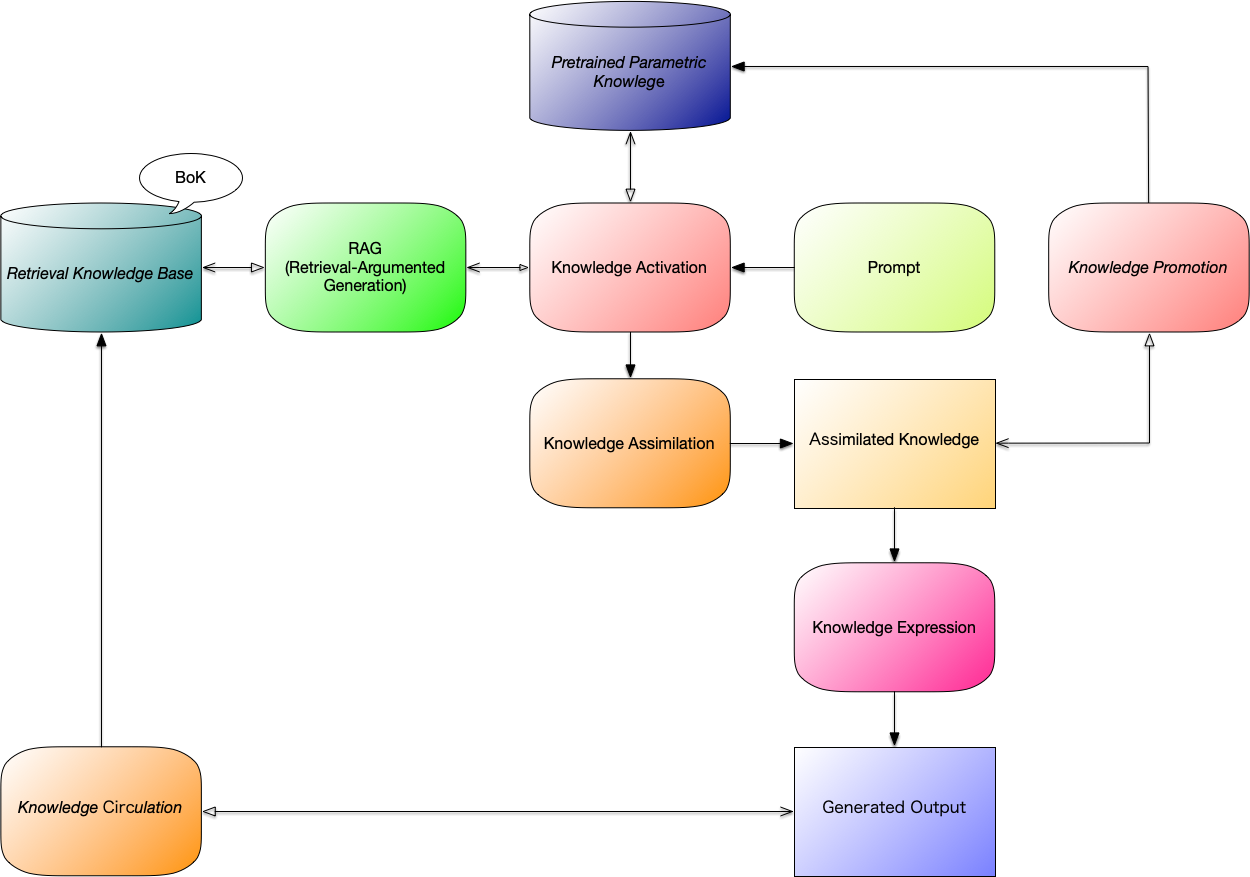
The Generative AI Reference Architecture defines the AI Collaboration Architecture as a conceptual structure that illustrates how AI activates, assimilates, expresses, and circulates knowledge through collaboration with humans.
Inside AI, the process begins with Knowledge Activation. Here, the AI references external sources such as the BoK as a Retrieval Knowledge Base, as well as its internal Pretrained Parametric Knowledge, to retrieve knowledge relevant to the given prompt. Through mechanisms such as RAG, the AI forms the necessary context for reasoning and generation.
Next, in Knowledge Assimilation, the retrieved knowledge is internally integrated and semantically restructured. At this stage, the AI “understands” the information and aligns it with its internal context.
In the subsequent phase, Knowledge Expression, the assimilated knowledge is expressed in various forms—text, code, or structured data. The result of this process constitutes the AI’s Generated Output.
The generated knowledge then diverges into two paths. The first is Knowledge Promotion, representing AI’s autonomous learning and internal evolution. Useful portions of the generated results are incorporated into the AI’s internal structure as Pretrained Parametric Knowledge, an accumulation of tacit knowledge that strengthens the AI’s cognitive foundation.
The second is Knowledge Circulation, in which humans intervene to evaluate and reorganize AI’s outputs, feeding them back into the BoK. These results are curated and structured as SmartDox documents or CML models, thus reintroducing the AI’s generated knowledge into the system as explicit, shareable knowledge.
Thus, within AI, knowledge is processed in three phases—Activation → Assimilation → Expression— followed by two distinct pathways, Promotion and Circulation, for elevation and sharing. AI not only evolves internally but also collaborates with humans to continuously expand the BoK.
This architecture demonstrates that AI is not merely a generative engine, but an entity that internalizes, expresses, elevates, and circulates knowledge— forming a cyclical relationship with human intellectual activity. Through Promotion, AI accumulates tacit knowledge internally, while through Circulation, humans systematize that output into explicit, shareable knowledge. Together, they enable the BoK to evolve continuously and deepen AI’s understanding of knowledge itself.
Perspective
In SimpleModeling, the SmartDox site integrates human-authored documents and CML models, and the SmartDox command transforms them into a unified BoK. Through RAG, AI internalizes this BoK, connecting the structures described by humans with the knowledge it has learned, thereby forming a shared space of understanding.
By repeating cycles of assimilation and circulation, knowledge evolves through human–AI collaboration. The BoK expands, and AI progressively attains deeper understanding.
This collaborative evolution is expected to shape the future of Literate Model–Driven Development in the AI era, where software development and knowledge development are seamlessly integrated.
References
Glossary
- BoK (Body of Knowledge)
-
At SimpleModeling, the core knowledge system for contextual sharing is called the BoK (Body of Knowledge). The goal of building a BoK is to enable knowledge sharing, education, AI support, automation, and decision-making assistance.
- Glossary
-
A Glossary is a knowledge resource that manages the names, meanings, boundaries, synonyms, and identifiers of terms used in a subject domain. It provides a common foundation for participants to use the same terms with the same meanings.
- CML (Cozy Modeling Language)
-
CML (Cozy Modeling Language) is the SimpleModeling formal modeling language for describing the Executable Model portion of an Object Model that connects to program generation and execution.
- DSL (Domain Specific Language)
-
A DSL (Domain-Specific Language) is a language designed for a particular domain, enabling direct and concise expression of the domain’s concepts and structures. Compared to general-purpose programming languages (GPLs), DSLs offer a higher level of abstraction tailored for domain-specific problem solving and automation.
- StateMachine
-
In UML, a StateMachine is a Behavior that expresses the event-driven Behavior of a system element by traversing a graph of States through Transitions triggered by Event occurrences.
- Model
-
A Model is an abstraction that represents a subject according to a particular Purpose and Concern so that it can be understood, reasoned about, evaluated, or constructed. It is not the subject itself; it preserves the elements, relationships, and meanings required for its purpose.
- Type
-
Undefined
- Object
-
An Object is an Instance classified by a Class or another Classifier and may have structure, State, and Behavior. It is treated as an individual that can be referred to separately from other Instances of the same Classifier.
- Model Context Protocol (MCP)
-
The Model Context Protocol (MCP) is an open protocol for connecting applications that use generative AI with external data sources and tools and for providing context and capabilities in a standardized form.
- RDF
-
A W3C-standardized data model that represents information as subject–predicate–object triples.
- knowledge graph
-
A semantic graph-based knowledge base where nodes represent entities or concepts and edges represent their relationships.
- knowledge assimilation
-
A temporary internalization of external knowledge retrieved from the BoK through RAG. It enhances reasoning within a session but does not permanently modify the AI model’s parametric knowledge.
- Component
-
A software construct that encapsulates well-defined responsibilities, contracts, and dependencies as a reusable and replaceable unit. In the logical model, it serves as an abstract structural unit; in the physical model, it corresponds to an implementation or deployment unit.
- Retrieval-Augmented Generation (RAG)
-
A generation technique that supplements a language model’s internal (parametric) knowledge by retrieving relevant external information before generation. RAG systems first search knowledge sources such as databases or knowledge graphs and then use the retrieved context as input for text generation.
- Feature
-
In UML, a Feature is a structural or behavioral characteristic of Instances of a Classifier. Features include Structural Features such as Attributes and Behavioral Features such as Operations.
- Cozy
-
Cozy is the SimpleModeling toolchain that analyzes Models expressed in CML and other DSLs and transforms them into realization artifacts such as programs, configuration, and documentation.
- SimpleModeling
-
SimpleModeling is a modeling-centered software development methodology and technology system for constructing a Domain Model from Knowledge, formalizing it in CML, realizing it as executable software through Cozy and AI, and running it on Textus.
- Generative AI Reference Architecture
-
An architecture that organizes the internal processes executed by generative AI: knowledge activation, assimilation, expression, promotion, and circulation.
- Collaboration
-
In UML, a Collaboration is a Classifier describing a structure of participant Roles that perform specialized functions and collectively accomplish desired functionality.
- Retrieval Knowledge Base
-
Retrieval Knowledge Base (RKB) is a structured, retrievable subset of Non-parametric Knowledge optimized for use by RAG (Retrieval-Augmented Generation). It contains indexed SmartDox documents, glossary entries, and semantic metadata, allowing AI models to fetch explicit knowledge as contextual input. Through RAG interaction, the RKB serves as a bridge for transforming external explicit knowledge into intermediate assimilated knowledge within the AI model.
- Parametric Knowledge
-
Parametric knowledge refers to implicit knowledge embedded in the parameters (weights) of a neural network. It represents statistical or distributed information acquired during pretraining, rather than explicit facts stored in an external knowledge base. In RAG (Retrieval-Augmented Generation), it is contrasted with non-parametric knowledge, serving as the model’s internal “implicit value.”
- Prompt
-
A structured instruction or contextual representation that bridges retrieved knowledge (RAG) and the AI model’s reasoning process. It transforms the structured knowledge from the BoK into a narrative or directive form that the model can interpret, act upon, and internalize.
- assimilated knowledge
-
A semantically integrated knowledge state within the AI, constructed from the context produced by knowledge activation. Corresponds to “understanding” within the AI.
- Knowledge Promotion
-
A long-term integration process in which structured knowledge from the BoK is permanently incorporated into the model’s Pretrained Parametric Knowledge (PPK) through retraining or fine-tuning.
- Literate Model-Driven Development (LMDD)
-
Literate Model–Driven Development (LMDD) is a software development methodology that integrates natural-language narrative and formal model structure within a unified text-based framework. It extends conventional Model–Driven Development (MDD) by treating documentation and models as a single, consistent source of truth. In LMDD, the descriptive and structural elements of development artifacts are expressed together using the SmartDox language. From this unified representation, ModelDox extracts structural data, CML (Cozy Modeling Language) defines domain-specific models, and Cozy generates executable code, documentation, and configuration artifacts. Artificial intelligence participates in the LMDD process by analyzing the narrative context, validating structural consistency, and supporting the refinement of models and generated artifacts. All artifacts are represented in text form, ensuring traceability, version control, and interoperability within standard development environments. By defining a formally connected and machine-interpretable relationship between documentation, design, and implementation, LMDD provides a foundation for AI-assisted model–driven engineering where human authorship and automated reasoning operate on the same representational layer.